The Castelo de São Jorge is one of Lisbon’s great iconic monuments. Defining the skyline, it rises over the city from its perch on top of Alfama Hill. Each year, millions of visitors climb its ramparts and scale its parapets, as people have done (more or less) for a millennium.
It was designed to be an impregnable fortress, and bears some of the best that 11th century defensive technology has to offer. It sits at the pinnacle of the highest hill in the old city, has layers and layers of thick walls, and was easily supplied by the fresh water that once bubbled from hot springs below.
But it was almost never fought over.
That’s not because Lisbon has always been peaceful—it has been raided, besieged and conquered over a dozen times from when the first walls were erected there until the castle was abandoned and transformed in the 16th century. But the castle itself was rarely ever directly assaulted. If anything, it was because the castle is simultaneously too good at its job, and has something of a fatal design flaw.
The Foundations
The Castelo itself is not the oldest surviving fortifications in Lisbon; that honor goes to its old walls, also called the cerca velha. They were built by the Romans for the same reason most Roman cities built their walls. No, it’s not because they were concerned about attacks from so-called “barbarians” or overseas invaders. They were actually much more concerned with civil strife—the waves of usurpations, civil wars that wracked the Empire from the 3rd to 5th centuries CE. The threat was coming from inside the Empire.
The very oldest walls
I’m careful to say that the Romans built the oldest surviving walls, because we know from recent archaeology that castle hill has been inhabited since at least the Iron Age (around 500BC), so it’s likely there have been fortifications on that site for a very, very long time.
Let’s go to the map!
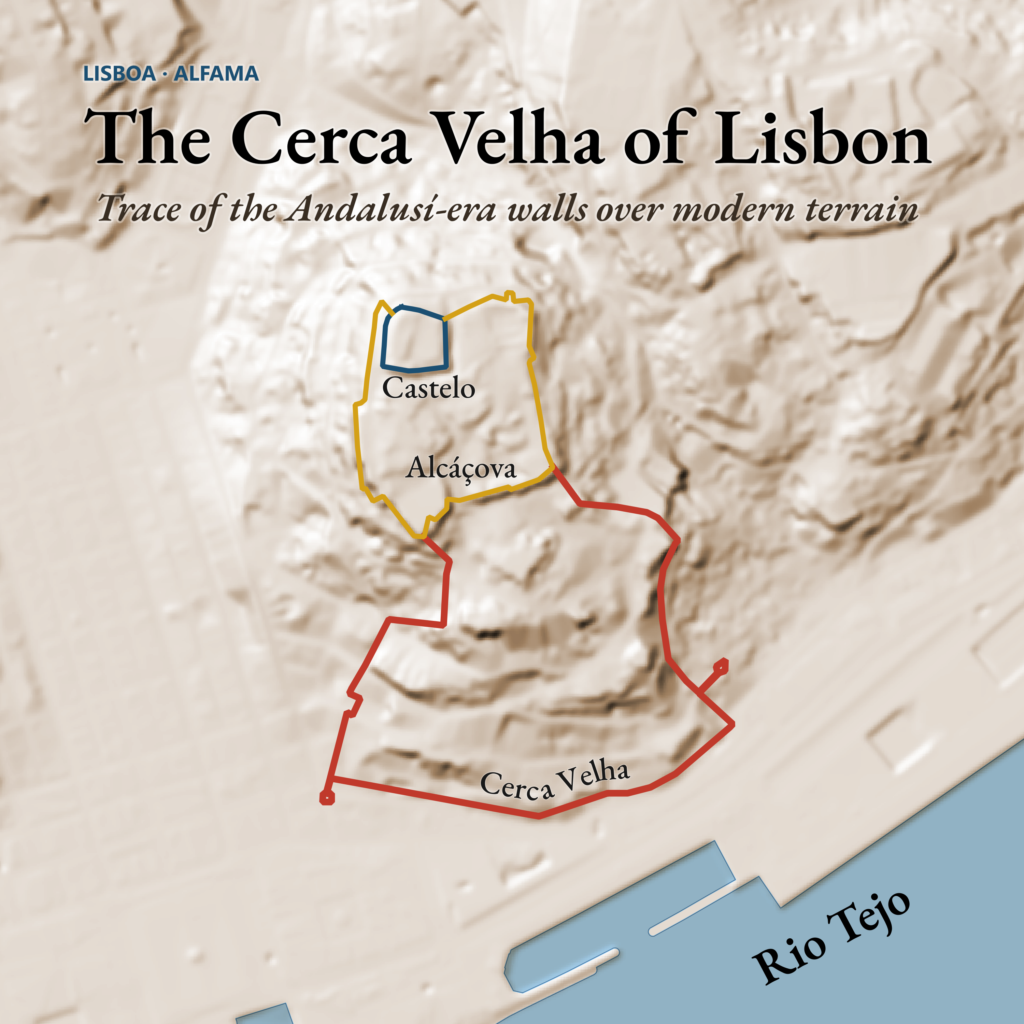
The cerca velha has two parts: a core ring protecting an “upper city” at the very top of the hill, and a larger band that draped itself down the hillside and skirted the very edge of the river Tejo (though today, the river has been pushed about 100 meters away by landfill).
That walled “upper city” was the most-defensible place, with dangerous cliffs protecting several sides. As such, it probably housed the city’s military elite. The outer wall protected the city-at-large. And it seems to have done its job relatively well, though there is a lot we don’t know. Lisbon came under control of the Visigoths in the 6th century, but we have no documents or archaeology to explain how or even when exactly that happened. Similarly, when the Umayyad Caliphate conquered Lisbon in 714, leading to 330 years of Muslim rule there, the sources—both documentary and archaeological—are frustratingly sparse. We may never know whether the city walls were ever contested in these conflicts.
One way or another, during the period of Muslim rule the rulers of Lisbon (then called al-Ushbūna) decided it was time for an upgrade to the walls. That’s unsurprising, since unlike the Romans they did face threats from both internal conflicts and from overseas invaders. For example, bands of Vikings attacked Lisbon several times. Most of these were small pirate raids, though in 844CE, according to the history written by Ibn Hayyán, a large Viking army fought three battles in Lisbon over a span of 13 days before moving on to sack Seville.
The who?
You may not have heard some of the terms I’m using here because I’m intentionally not using the common term “Moors”, which is rarely used by modern historians since it is both racist and not very accurate. The best term collectively for the people who lived in Iberia under Muslim rule is Andalusí, since they called this place al-Andalus. The initial conquerors were from the Umayyad Caliphate centered in Damascus, but the Andalusí quickly broke away, created their own center of power and founded their own Caliphate!
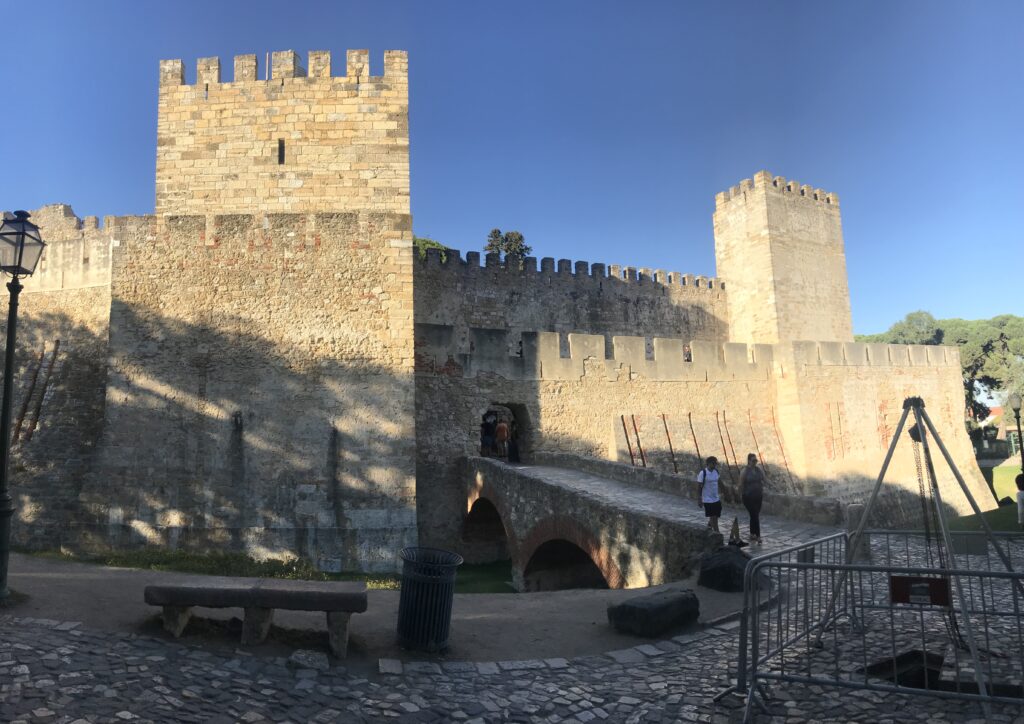
But this wasn’t the only change from that time; the “upper city” of the Romans was transformed into an Alcáçova (from the Arabic al-kasbah)—a full gated-neighborhood palace-city that housed the ruling elite. The lower city was, therefore, the medina—with the general population, markets, mosques, etc. Outside the protection of those lower walls, you would find suburbs containing anything they wanted to keep out, for example industrial buildings or cemeteries (several of which have been recently excavated).
This is when the castle was built within the walled Alcáçova. And though, of course, at this time it was not called by this name, it is that castle which we call the Castelo de São Jorge.
A Castle within a Castle within a Castle
But… why?
There already was a wall around the medina, and a wall within that protecting the Alcáçova. Why build yet another (massively expensive and difficult) layer of defense by building a castle?
We can’t know for certain, since there are (as you might guess) no explanations from the architects. But if we look at similar cities, a pattern emerges. In the Spanish cities of Badajoz, Málaga, or Granada, we find similar structures—layers of redundancy, walls within walls within walls, also built during the Andalusí period.
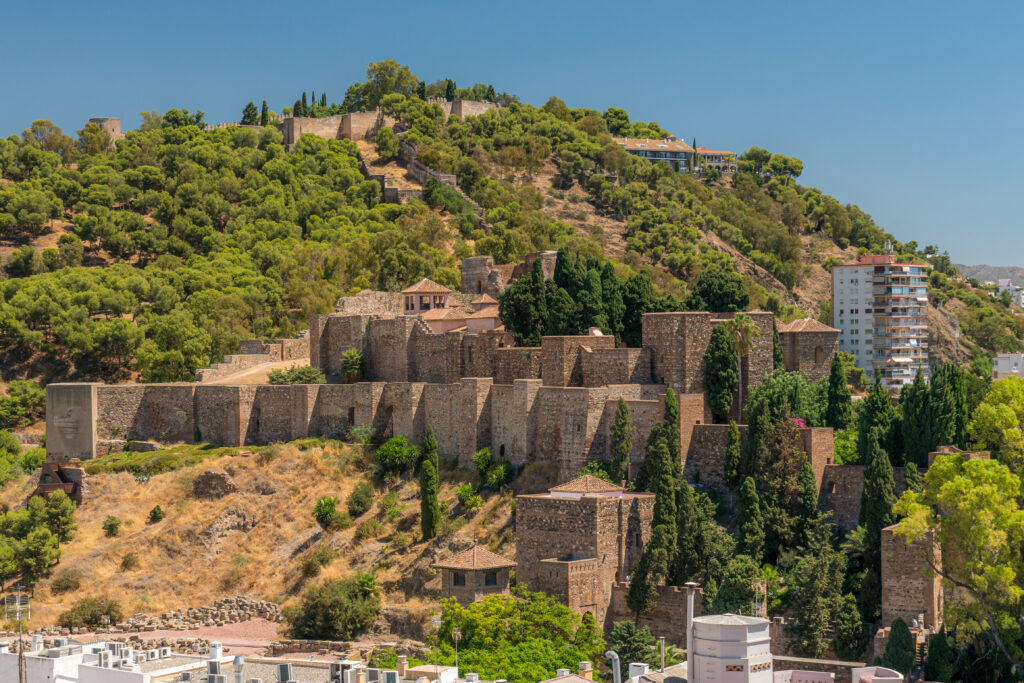
To some degree, this is just smart tactics. Today we call it “defense in depth”: creating layers of fortified positions so that you can safely fall back when the outer ones are taken. But there are other elements as well. It is a physical manifestation of political reality: the layers of society are separated by walls and guards, which can control the movement of people between. And it is no accident that the ruler’s retinue and personal guards are in the highest, most defensible point. They knew, wisely, that they had to defend against enemies both foreign and domestic.
When exactly
There is much debate on when the Castelo was first built; a founding stone gives a date of 985CE was discovered by excavations in 1939. But recent archaeology has shown that that date is probably wrong. It is far likelier to have been around 100 years later in the mid-11th century.
Did It Work?
This strategy was effective… sort of.
Lisbon’s city defenses were able to repel major assaults several times. The most famous battle for control of Lisbon was undertaken in 1147 by Afonso Henriques, who was seeking recognition as the first King of Portugal. But he knew how strong the defenses were: he had been repelled by the walls of Lisbon just five years prior.
When Lisbon changed hands in 1147, it wasn’t due to a major assault like you see in the movies. It happened similarly to how most medieval cities did: after a prolonged siege. The greatest weapons—on both sides were starvation, disease, and despair. In the case of Lisbon, the surrender of its Andalusí rulers was negotiated after six months of skirmishing, when the defenders finally received word that their allies could not help them.
But that was not the only time that Lisbon was conquered.
In 1373, the city surrendered to the forces of the King of Castile (which ultimately became modern-day Spain) and was sacked after losing a disastrous battle for control of the river. It was besieged again in 1384, but this time it was the attackers who lost after four months of plague and skirmishing with the Portuguese.
In none of these battles did the Castelo come into play at all. The fighting—when there was any—was at the outer walls, in the suburbs, or naval battles for control of the river.
1383
One of the few times that the Castelo was truly tested was in the many medieval internal wars over the Portuguese crown. Lisbon was besieged by the Castilians in 1384, but one year prior, in 1383, there was a conflict between different factions of the Portuguese nobility over the crown. Rebel forces (led by the Master of the Military Order of Avis) managed to capture the lower city of Lisbon.
They then laid siege to a group of about 150 holdouts loyal to the Queen within the Castelo itself. The rebels considered attacking the fortress with a siege tower, but instead exploited a key weakness of the “citadel within a city within a city” design. Since they had already captured the defenders’ wives and children when they took the city, they simply threatened to tie them to the front of their siege tower. The Queen’s forces quickly capitulated.
what’s this about?
The 1383 and 1384 battles for Lisbon are part of the same conflict called the Interregnum. As simply as I can put it, in 1383 the Portuguese King died. He left the kingdom to his only daughter, Beatrice, with whom he had arranged a marriage to the king of neighboring Castile. This meant that the crown of both kingdoms would go to their children, effectively unifying Portugal and Castile. This was completely unacceptable to some Portuguese nobles. So, they rebelled with the help of the English, and put a new candidate on the throne as João I. This conflict solidified a long-standing alliance between Portugal and England against the Castilians.
After this, though Lisbon changed hands several times in various wars through the centuries, the Castelo was never seriously tested again.
This makes some sense. As advances in gunpowder technology brought better and better cannons into the mix, straight-walled castles turned from impregnable holdouts into easy targets. And as the previous medieval sieges made quite clear: the city matters more than the fortress. If the city is captured, the rest is details.
The Other Face
But that was only one function of the Castelo. Over time, the inner citadel became more and more obsolete, but the Alcáçova, the gated neighborhood at the top of the hill, kept its symbolic importance for a time. After the initial conquest of Lisbon in 1147, the Portuguese royal family took up residence in the Andalusí-era palaces that already existed within the walls.
By the mid-1200s, we know that a new royal palace was built next door, and possibly even connected to the Castelo; this complex came to be known as the Paço de Alcáçova “Palace of the Kasbah”. It had all the great halls, royal apartments, service buildings, and servants’ quarters you might expect of a medieval royal abode—none of which remain to this day.
The Castelo itself also had a royal refit. One tower of the Castelo was turned into the royal archive (an institution that is still called the Torre do Tombo, “Tower of the Archive” despite moving out of the tower centuries ago). Another tower was made into the royal treasury.
palace theater
The first known performance of a play by Gil Vicente, the leading figure in Portugal’s early modern theater scene was done in the Paço de Alcáçova. It was a short one-man chamber piece called, I kid you not, Cowboy Monologue (“Monólogo do Vaqueiro”); it was performed in 1502 for the queen and court while she was recovering from giving birth to the future João III. It is an irreverent take on the story of the shepherds at Christ’s birth.
But by the early 1500s, any glory that the Castelo had was gone. Both the Castelo and the palace had fallen out of fashion; the king at the time—Manuel I—decided to be done with it and ordered a new royal residence to be built along the waterfront downtown. What had once been the low suburbs outside the walls where people would go to ferment fish or bury their dead had turned into the bustling heart of the city. The new palace reflected that reality. And the Alcáçova, which had once been the fanciest of gated neighborhoods, slowly gave way to grinding poverty.
Over the next few centuries, the old castle/palace complex was returned to the original role it held under the Romans: as a military camp. The archive was still there, but the castle was transformed into a barracks, hospital for soldiers, military jail, armory, magazine, and storage yard for weapons of war.
By the time that the great Earthquake of Lisbon came in 1755, the Castelo was a shadow of its former glory. The palace and bustling heart of downtown was annihilated by the quake and the tsunami and fire that followed. The castle on the hill and its walls fared a bit better—though the remnants of the Paço de Alcáçova were destroyed. The Castelo had been built centuries before by people who understood the value of building on a foundation of bedrock rather than on muddy river infill. But the real damage had already been done due to obsolescence, which led to neglect, which led to poverty.
…Until it Did.
But there’s a twist.
You see, there was one occasion in which there was a true pitched battle for the Castelo de São Jorge. Not a siege decided long prior, but an ongoing military action to take the castle by force.
Portugal’s military overthrew the First Portuguese Republic in 1926 establishing a military dictatorship. But only two years later, soldiers from the 7th Hunters Battalion stationed at the Castelo de São Jorge revolted against that dictatorship, demanding a return to constitutional civilian government. It was an act of brave defiance and resistance known today as “A Revolta do Castelo”: the Castle Uprising. It was coordinated with civilian strikes and military uprisings around the country.
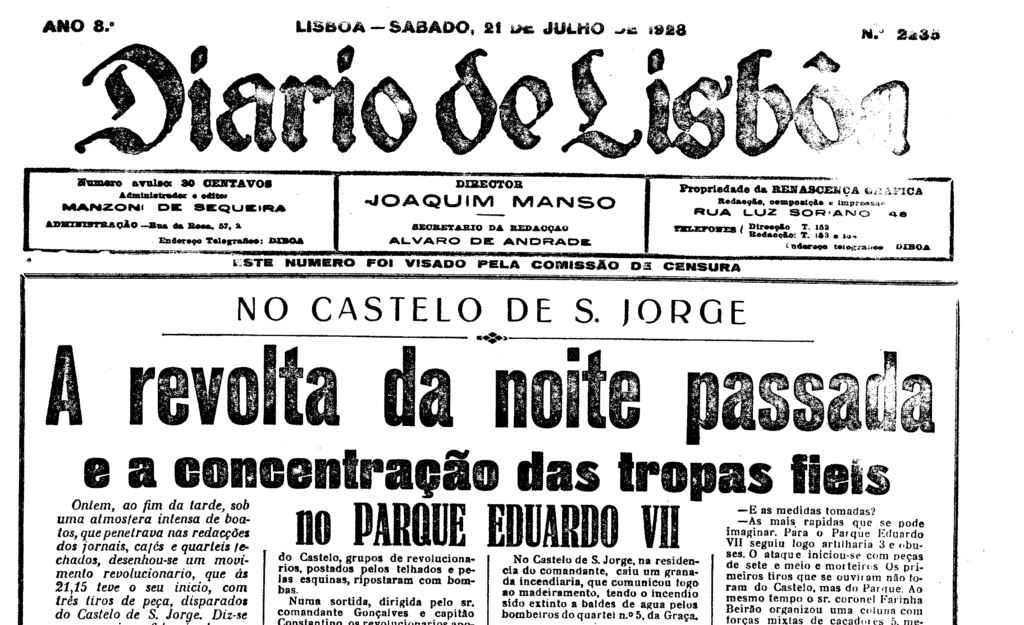
The opening salvo was, as reported in the Diário de Lisboa newspaper the next day, three warning shots from the castle as evening fell on the 20th of July. The dictatorship’s forces responded with artillery fire of their own that night:
contemporary account
“Artillery Unit 3 took up positions on the grounds of Eduardo VII Park, responding to the shots fired from the Castle with five shells. The lower part of the city was in darkness. At various points—Camões Square, Bairro Alto—G. N. R. [note: the National Republican Guard] cavalry forces and “trucks” packed with troops could be seen. The barracks were closed under orders of the strictest vigilance. In the nearby streets, sentries fired into the air from time to time, frightening the few onlookers who dared to venture out.”
The paper calls what happens next “O cerco ao Castelo”—The Siege of the Castle. Armored vehicles and cavalry patrolled the city, firing warning shots to scare off civilians.
“At 11:00 p.m., the Republican Guard, stationed at the Cabeço de Bola barracks, was ordered to advance on the Castle in order to subdue the revolutionaries. The troops advanced in echelons along Madalena Street, Mouraria, Augusto Rosa Street, and the corners of Rossio, firing as they went. From the vicinity of the Castle, groups of revolutionaries, positioned on rooftops and at street corners, returned fire with hand grenades.”
An incendiary shell sets the commander’s residence ablaze. The forces of the government advance supported by armored vehicles and exchange heavy fire with the revolutionaries.
When the smoke clears, the newspapers gave no numbers of casualties under strict censorship orders. Historian Renato David Simões Nunes concluded in his doctoral dissertation that: “The July 1928 coup attempt resulted in eight deaths, about 30 injuries, 102 military personnel dismissed from the Armed Forces—89 of whom were deported to Angola—and several dozen civilians detained.”
And though the newspaper was silent on the number of revolutionaries and casualties, it was eager to name-and-shame the forty-one men arrested by the political police that night, an ominous sign of the decades of secret policing Portugal would endure under its dictatorship.
Ultimately, the Castle Uprising was crushed. In its millennium of existence, this was the only time that we know the Castelo de São Jorge was conquered by assault.
The Walls Remember
The Castelo de São Jorge was designed around the logic of medieval warfare. And in that role, it was largely untested because it was largely redundant. By the time the Castelo was in play, the fight was a foregone conclusion. Perhaps, as the designers intended, its towering presence made most rebels within the city think twice.
Today, the castle is presented as one thing: a static symbol of medieval military might, quite literally lording over the city below. But that is only one barely-used facet of its life. Another facet is revealed by extensive, recently-discovered medieval graffiti that you can find on one of the towers and along the foundations—but only if you know where to look. In the wet plaster of the medieval castle, unknown people tagged it with their name, they drew ships and labyrinths, and more than anything else, they etched game boards into the surface.
The castle was housing people for centuries—nobles, governors, soldiers, servants, archivists, actors. Children were born there, and bored there, and were, only very occasionally, threatened with being tied to a siege engine there.
Its most dramatic day came well after it had been abandoned and repurposed, a decade before a dictatorship would remake it into a monument to battles that mostly never happened here. We end our History Lover’s Intro to Lisbon tour at the Castelo de São Jorge because it’s one of the few places where you can find almost two thousand years of Lisbon’s history in a single walk, if you know how to find it.