Momentous events in history inevitably spawn myths. Even as events are unfolding, people fight over not just the basic facts at hand, but maybe more importantly what those facts mean. The Portuguese Carnation Revolution of 1974 is no exception.
In the current political climate around the world, with dictators and wannabe dictators rearing their ugly heads, understanding how past revolutions happened is more important than ever. Most of the visitors to Portugal who I meet don’t know much about its past. That’s not a dig—it’s understandable! (And if everybody already knew everything, I would be out of a job!)
Portugal doesn’t feature much in the high-school history curricula in the US or UK. If 20th century Portugal comes up at all, there might be a paragraph about the Carnation Revolution. Though when I was growing up, I remember all my US history classes petering out somewhere around Eisenhower’s presidency (I wonder why…).
Here in Portugal, the memory of the revolution is obviously very different, particularly since there are many people alive today who lived through it. On the 25th of April 1974, the Portuguese dictatorship was finally brought down. Portugal suffered under the longest dictatorship in Western Europe: starting in 1926 with a military coup against the beleaguered First Republic, and then taken over from within by Antonio de Oliveira Salazar in 1933. The dictatorship lasted 48 years. It was brutally oppressive and murdered hundreds of people in mainland Portugal, and thousands more in the colonies. Anyone in Portugal who was born prior to April 1974 was born, raised, and experienced daily life under the thumb of an oppressive dictatorial regime.
But the events of 25th of April were quickly mythologized—by both sides of the conflict. Those myths have persisted to this day, and even many Portuguese people might be surprised to find out that what they’ve heard about the revolution isn’t entirely true.
Myth 1: The Carnation Revolution was Bloodless
The relative peace of the day was founded on the sacrifices of thousands.
This is maybe the most common myth about the Portuguese Revolution, and it might be the most destructive. The story goes that the revolution which brought down the dictatorship was a bloodless, even non-violent affair. If this were true, it would make the Portuguese almost-unique in their ability to bring down a brutal dictatorship without violence.
But it’s not true, on a number of levels. Here’s the summary:
- On the day of the revolution, at least 4 people were killed, and possibly more. That number is very low, which is itself remarkable, but it is not zero. Their sacrifices must be remembered.
- After the revolution, there was a tumultuous transition to democracy over a year and a half. Violence exploded with conservatives and fascists burning and bombing the offices of labor organizers and socialist political parties. Hundreds died.
- After that, some refused to put down their weapons: there were two attempted coups during the transition to democracy. Even after that transition was complete in 1976 with the new constitution, some of the heroes of the Carnation Revolution became terrorists and conducted bombings through the 1980s.
- The revolution began as a military coup. The military likely would not have rebelled against the government had they not been sent to wage war against African revolutionaries in the colonies of Angola, Mozambique, and Guinea-Bissau. The foundation of the Carnation revolution was built on the bodies of the Portuguese soldiers who were killed in Africa.
- And let’s reframe things a bit. The Portuguese revolution could not have happened if those colonies had not rebelled. Their fight for freedom and independence against their Portuguese oppressors was a noble one. As the Portuguese government maintained a death-grip on those colonies, things got worse and worse for everyone. It was those colonies, and the sacrifice of thousands of Black Africans which broke the army’s will to fight, and in turn, the Portuguese dictatorship. Without the rebellion, the revolution never could have succeeded. Democratic Portugal owes them a huge debt of gratitude.
Myth 2: It Was a Spontaneous People’s Revolt
It was a military coup that became a people’s revolt. And if it hadn’t been, it probably wouldn’t have worked.
There is another mythology about the Carnation Revolution that it was fundamentally a people’s uprising against the government. For those of us who believe in democracy, the idea is appealing: that civilians can rise up in non-violent protest and bring down a brutal dictator with the sheer power of our collective moral condemnation.
I’m not saying that’s impossible. But I am saying that is not what happened here.
The Carnation Revolution was first and foremost a military coup. The junior officers—famously the highest rank among the vast majority of revolutionaries was Captain—planned and executed this coup as a complex military maneuver. Their story was quite dramatic: including clandestine meetings, signals espionage, deceiving their superior officers, and horror as one of their number was discovered and jailed. It was far from spontaneous, it was planned to the T, and the leaders are rightly honored not as bomb-throwing firebrands, but as steely tacticians.
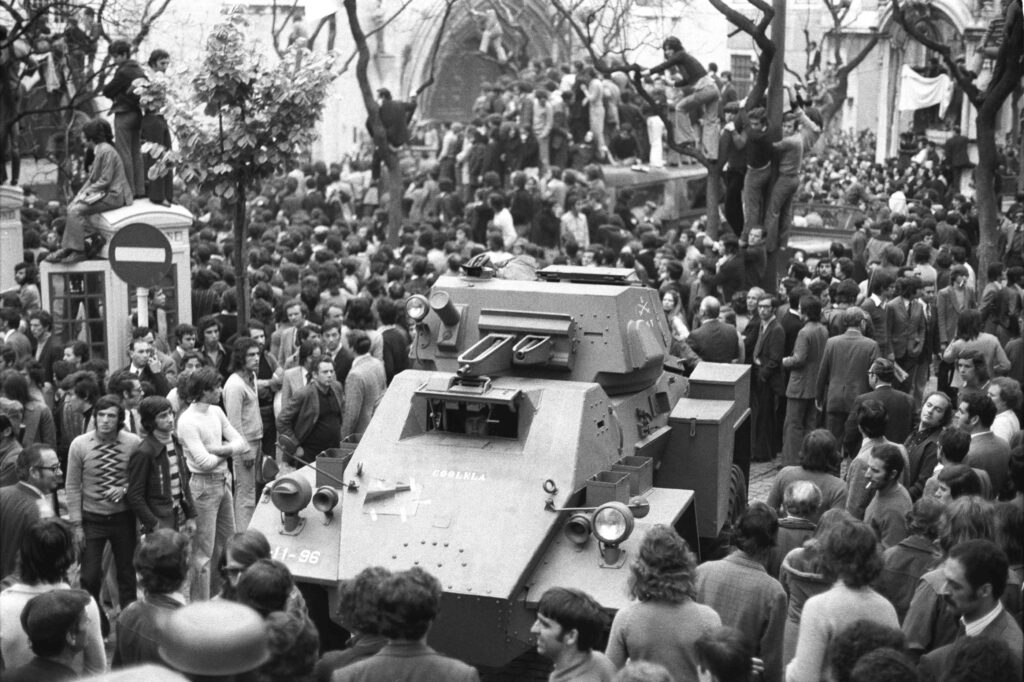
But, here’s the twist: the revolutionary officers sent messages radio insisting that the people stay inside and not get involved. Their first, at 4:26am, included:
“The Portuguese Armed Forces appeal to all residents of the city of Lisbon to return to their homes, where they must remain as calm as possible.” (my translation)
This was probably wise: if it had turned into a firefight, there could have been an absolute civilian bloodbath.
However, to their immense credit, the Portuguese people ignored those orders. They flooded into the streets and joined the revolutionaries. That may be one reason why it didn’t turn into a bloodbath: because those on the side of the Dictator might have hesitated before opening fire on a crowd of civilians. And even more, the huge presence of the people flooding the grand squares, laying siege to the dictator and the secret police meant that by the end of the day it was not just a military coup, it was both a coup and a popular revolution. This gave the people a stronger seat at the table in the days afterward. It may have prevented the revolution from just trading one dictator for another.
The takeaway is this: overthrowing an entrenched dictatorship without military action is very difficult. But overthrowing a dictatorship without popular support and sacrifice is the road to more of the same.
Myth 3: The Myth of the Red Carnation
The story of how the carnations became the symbol of the revolution is probably a bit of personal mythmaking. And they weren’t all red—at least on the 25th.
The story goes that on the day of the revolution, a woman named Celeste Caeiro was working in a restaurant just north of downtown. The restaurant planned to give out carnations to its customers that day, but news of the coup shut the restaurant down. Celeste then went downtown to Rossio Square and distributed the carnations to the revolutionary soldiers, which ultimately made the red carnation a potent symbol of the revolution (and particularly fed its image as a peaceful movement).
Celeste lived until the age of 91. She died in November of 2024, thankfully able to witness the 50th anniversary of the revolution that she participated in.
She went her whole life telling this story. The trouble is, I don’t really believe it.
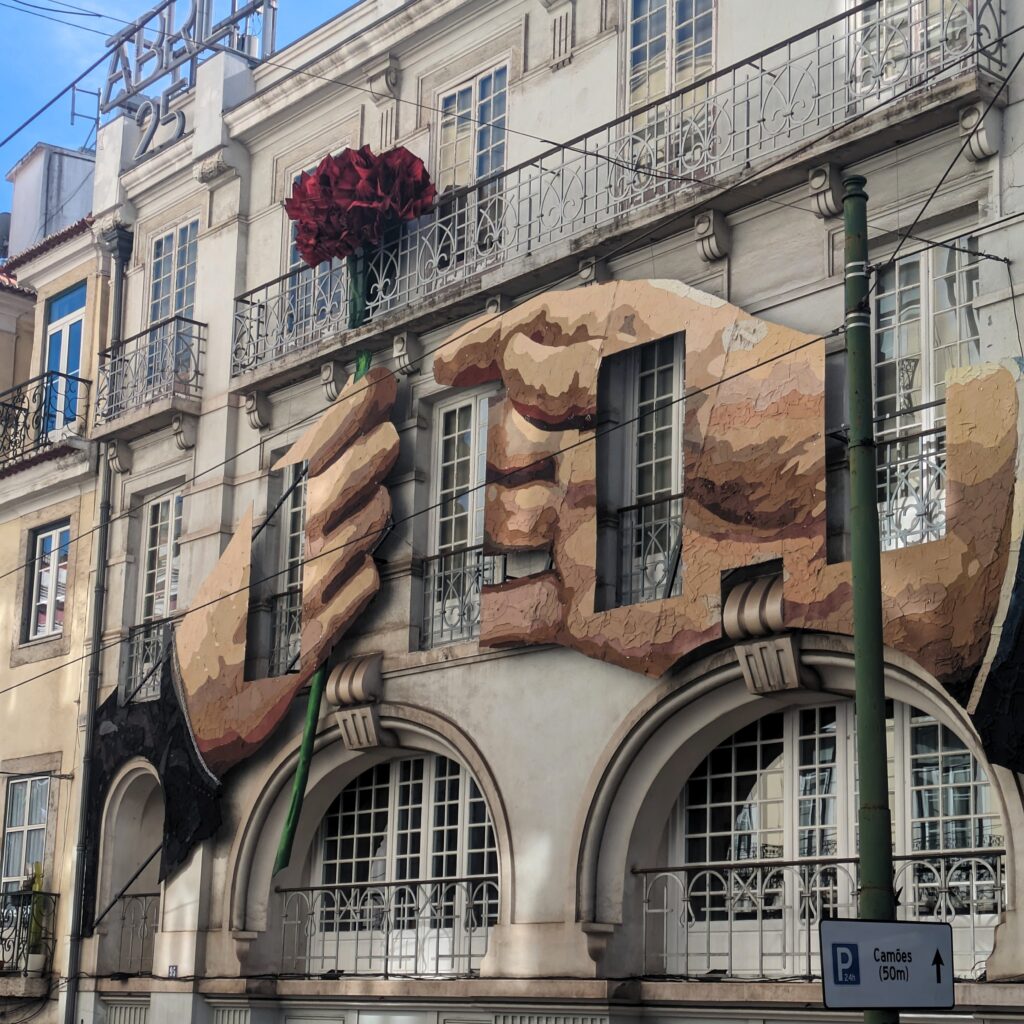
Let me be clear, I don’t necessarily think she’s lying. But I do suspect that she has done what we all do: we think of ourselves as the protagonists in our stories. And on days of intensely heightened events, and with re- and re- and re-telling of stories, our brains naturally mold our experiences into story.
The truth is that yes, many of the soldiers on the day are pictured with carnations. But there are far more of them than could have been distributed by one person. The far more likely possibility is that it wasn’t started by a restaurant worker from uptown with a bouquet, but probably by the soldiers as they passed the flower-sellers that lined the square (and still do). Those folks probably do not remember themselves as “the first” or “the person who started it all”. In the chaos and noise, and in the pressure-cooker events of the rest of the day, who can remember?
That’s the difference between memory and history, and the tough, tough work put in front of contemporary historians. Psychologists have been studying for years how we forge our lives from the stories we tell about ourselves (and vice versa). Good lawyers know that even honest eyewitness testimony can’t be trusted. Historians then have to be suspicious about any story in which one person—even a well-meaning one—steps into the leading role.
Myth 4: The Revolution Lasted One Day
The 25th of April was the most dramatic day, but the days that followed were just as important.
Here in Portugal, we celebrate the revolution on the 25th of April. And it’s true that the events of that day in 1974 were the most dramatic: over the course of those 24 hours, the revolutionaries rose up, laid siege to the centers of power, rebuffed or captured the opposition, were joined by the people in the streets, and successfully convinced the dictator to surrender and be sent into exile.
But like how Americans celebrate their revolution on July 4th, we all know that the day we commemorate is not a commemoration of just that day. Revolutions are messy, and the final results come down to the actions in the day, months, and years after.
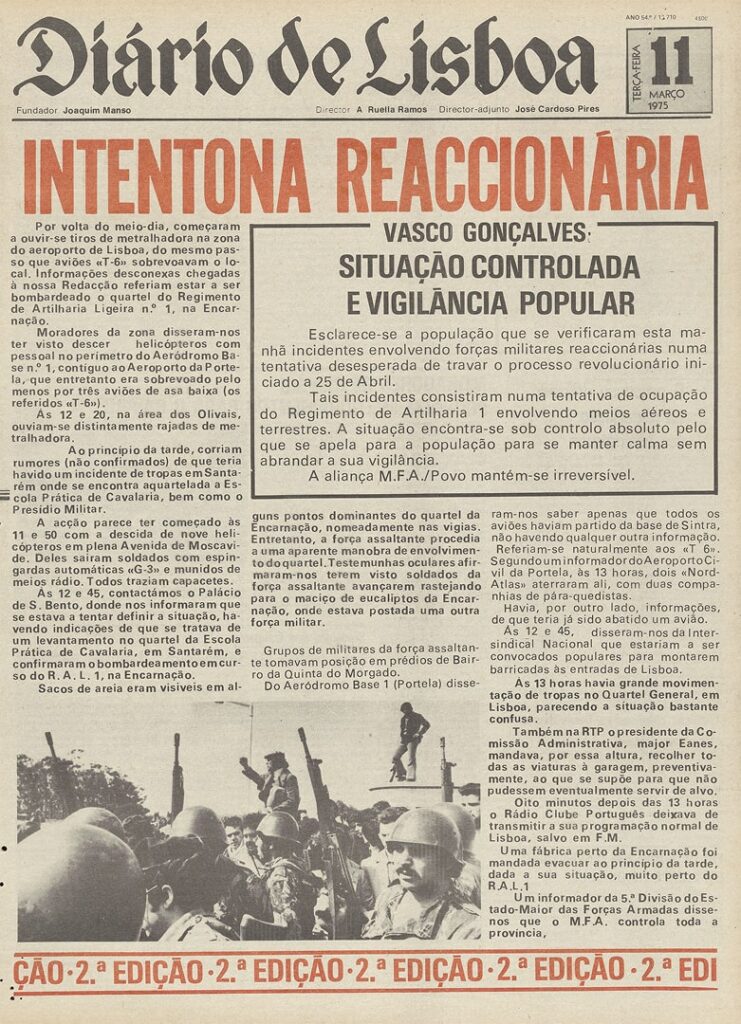
When it comes to the Portuguese revolution, 25th of April was just a turning point. It took about 18 months for the new government to stabilize, with months of tense negotiations, attempted coups and counter-coups, the rise and fall of several political factions, and even the… ahem… generous assistance of (in)famous US Secretary of State Henry Kissinger.
The core takeaway is that for those of us hungry for a spectacular revolution which will reverse our fortunes and reinvigorate our democracies, the real work—and the real danger—comes in the days after the dictator falls.
Myth 5: The 25th of November is Just as Important as 25th of April
The 25th of April and the 25th of November are not equals. The far-right wants you to think that the threat of communism is even worse than the reality of dictatorship.
This might not make much sense if you aren’t Portuguese, but it’s a critical thing to know about modern Portuguese politics. In recent years, the extreme right has been on the rise here, as they have been around the world. And though it is illegal for them to do so, they have been more-and-more defiantly talking about how they want to return Portugal to how it was under the dictatorship—how their fantasy of the dictatorship is preferable to the difficulties of democracy.
One of their tactics has been to downplay the memory of 25th of April. And so these new fascists and their conservative allies have been promoting the idea that the 25th of November should also be a national holiday.
Here’s why. On November 25th 1975—a small group of communist soldiers said enough was enough, that they could not abide by how the new government was betraying the ideals of the revolution and backsliding towards the right, and launched a counter-coup. Historians debate how serious of a threat this was, but at the end of the day it was a revolt of only one military unit and was put down quickly. After this, the new constitution was ratified, and political questions were solved through politics rather than threats of military overthrow.
The right will crow that this was the day that “Portugal was saved from communism” and that this makes it the equal of the 25th of April. There’s a shred of truth: Portugal had and still has a communist party that is quite openly soviet in its branding. The US and its NATO allies were concerned that Portugal could become a soviet-aligned state.
Perhaps the country is better off for not being a communist country in the Soviet model. But much like the statues we put up, the days we celebrate have to rise to a certain level. The downfall of the dictatorship on the 25th of April was a day that turned the tide for all Portuguese people. The specter of a theoretical communism does not compare to the reality of 48 years of dictatorship. Thinking those days are equal is part of a Cold-War mindset in which communism (and leftism in general) is the worst fate possible.
Yes, the revolution did not last one day. We can celebrate the 25th of November. We can celebrate it on 25th of April in the same way that Americans can celebrate the end of the Revolutionary War on July 4th. But we should only honor the 25th of November because it was the day that, for the most part, we decided to stop fighting. That’s when the revolution was finally able to end.
The Myths We Choose to Believe
Despite being only 50 years ago, the Carnation Revolution has accrued a wide range of myths. That’s because the day has power: it has become meaningful, really meaningful. The marches on that day still have teeth: they remain as much a political protest—pushing for a better world—as an act of remembrance.
At the marches on that day, the clarion call and response goes: “Vinte-cinco de Abril sempre! Fascismo nunca mais!” “The twenty-fifth of April forever! Fascism never again!”
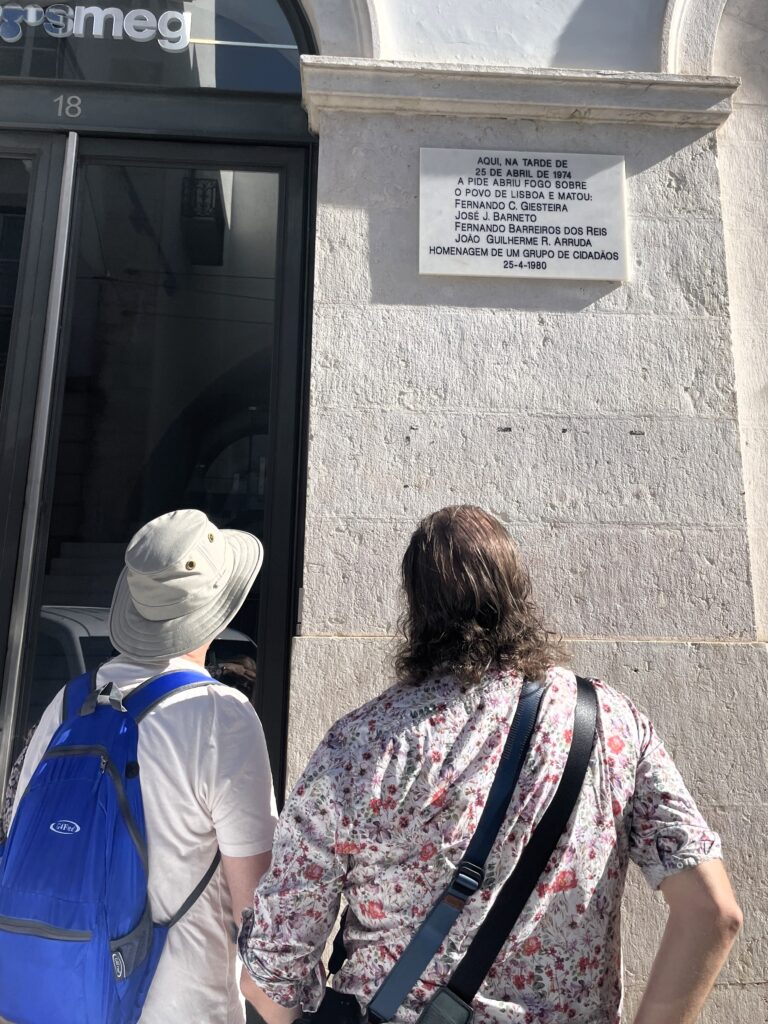
Many people choose to believe myths about days like this. Myths make the stories told on that day make sense, they reflect who we want to be and how we want the world to act. We want to think individuals can be the heroes of the story, that peaceful protest can bring down oppressors, that all we need is one brilliant day, led by one brilliant leader, and that the heroes will be remembered as heroes forever. But reality is more complicated.
The 25th of April 1974 was not a day of polished stories It was chaotic, complicated, and unclear. The people involved were everyday folks who ended up changing the world. That’s the version we walk through on our How to Overthrow a Dictator tour—not the postcard, the actual streets, and the arguments historians are still having. If you want to dismantle these myths in person, we’d love to have you.