The neighborhood of Belém is one of the most popular stops for people touring Lisbon. It features in every guidebook, and every large-group bus tour that I’ve worked for Smithsonian Journeys has had half a day there.
In Belém, one of the most-visited of the monuments is the Padrão dos Descobrimentos, a towering 150-foot concrete monolith. Every day, thousands of tourists visit, and as they do, they cross a massive mosaic underfoot. As you walk towards the center, what it depicts becomes clear: a compass rose, and within that, a map of the world. The map is covered with all the merfolk, wind-faces and sea creatures that you might expect to see on a 17th century map. But this one also is covered with dots and dates: each dot includes a date associated with the Portuguese expansion.
Everybody loves a good map. Children run across it. People pose for photos. Tour guides punctuate their speeches about Vasco da Gama’s voyage to India with it.
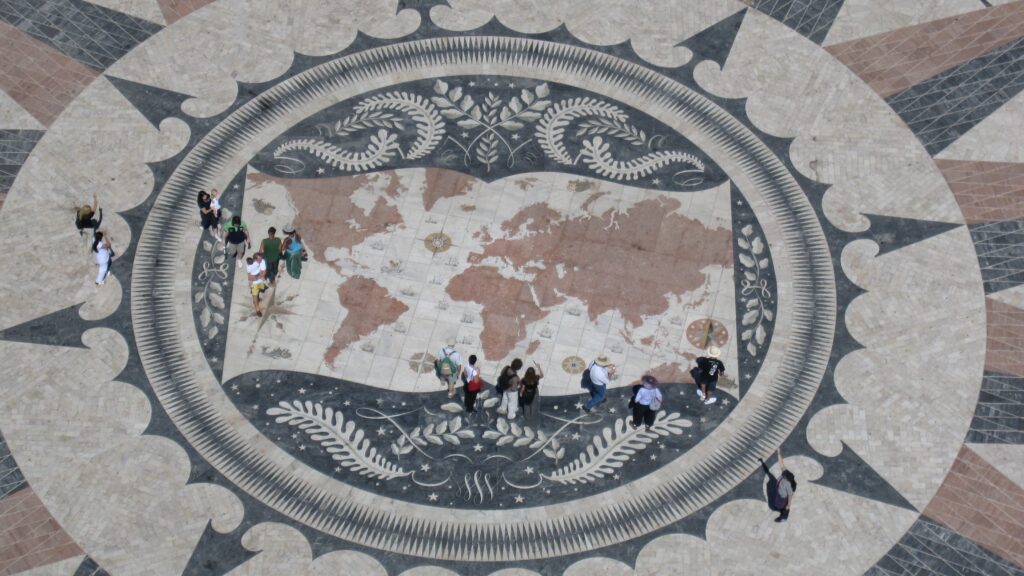
If you’re especially perceptive, you might spot a few anachronisms. A few of the dates are a bit off (Damão, for example, was captured in 1559, not 1509 as it states on the map). Some places are marked with the names of modern countries—especially, the countries of Angola and Mozambique.
That little inclusion—of the modern names of Mozambique and Angola—is no small accident. Their presence is a clue to unlocking the mystery behind what this really is, and why this is here.
The full answer comes at the very bottom of the compass rose, on a blink-and-you-miss it plaque. It reads:
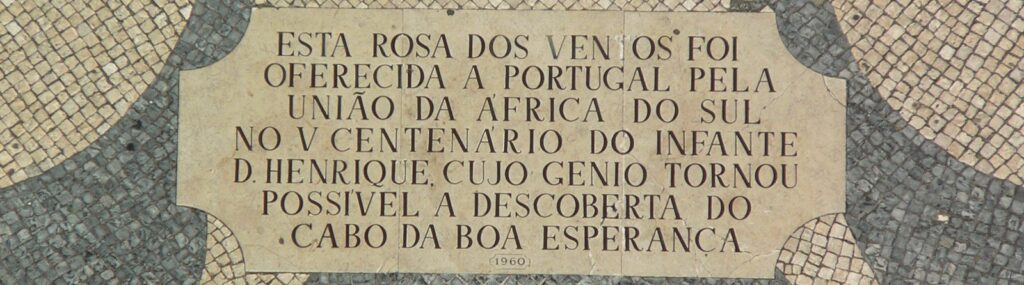
“This compass rose was given to Portugal by the Union of South Africa, on the 5th Centennial of Prince Henry [the Navigator], whose genius made possible the discovery of the Cape of Good Hope. 1960.” (my translation)
It was a gift from Apartheid-era South Africa. But why?
important context
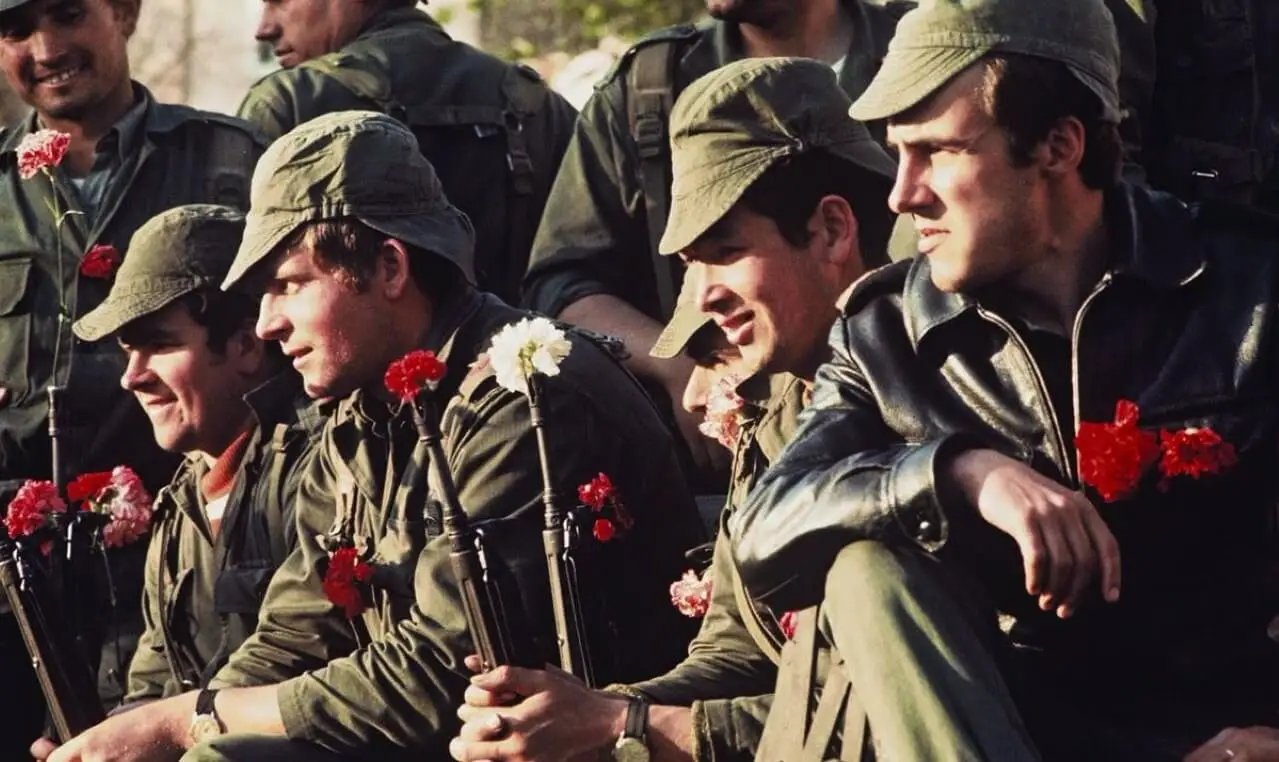
We tend to think of The Portuguese Empire as something out of history, with explorers looking through telescopes on the decks of wooden ships. But in reality, the Empire lasted until the Carnation Revolution of 1974. During that time, their largest remaining colonies were in southern Africa. Holding onto the colonies no matter the cost was a core belief of the Portuguese dictatorship.
Two Pariah States
The date is important. 1960 was a time of widespread displeasure with the Portuguese dictatorship (which called itself the Estado Novo, or “New State”). On the international stage, the Portuguese Empire was under intense criticism. They had been allowed to be founding members of NATO, since the NATO community could tolerate a brutal dictator so long as he was staunchly anti-communist. But their treatment of the Black Africans in their colonies of Mozambique, Angola, Guinea-Bissau, São Tomé, Príncipe and Cabo Verde was becoming harder and harder to defend. It made Soviet propaganda surprisingly easy: Look, this imperialism is what the ‘freedom’ of capitalism gets you.
Portugal pushed back with its own propaganda: Portugal’s Empire is based on love and cooperation! Portugal’s history makes it uniquely suited to be the One Good Empire! These are not colonies, they are our “overseas provinces”!
In 1960, South Africa was also under intense international scrutiny. On 21 March of that year, police opened fire on a crowd of people who were protesting against apartheid in Sharpeville, South Africa. Modern scholarship says that at least 91 people were killed, and over 200 were injured in what has become known as the Sharpeville Massacre. The fury within the country and internationally was immediate: the government arrested over 18,000 protestors in the days after the massacre. The Massacre was officially condemned by the UN.
The international community was splitting. 1960 was a momentous year for independence movements in Africa; in that year alone, 17 former colonies gained independence and established themselves as new nations. It was so dramatic that it it has come to be known as the “Year of Africa.”
But the world was splitting. On one side, those countries—like Britain with Ghana and Nigeria, or France with Niger or Chad—where Africans were able to use pressure to negotiate for independence without it coming to war. On the other side, what the Kennedy administration called “the White Redoubt” in southern Africa: including the Portuguese Empire’s colonies in Angola and Mozambique, as well as Rhodesia and the Union of South Africa.
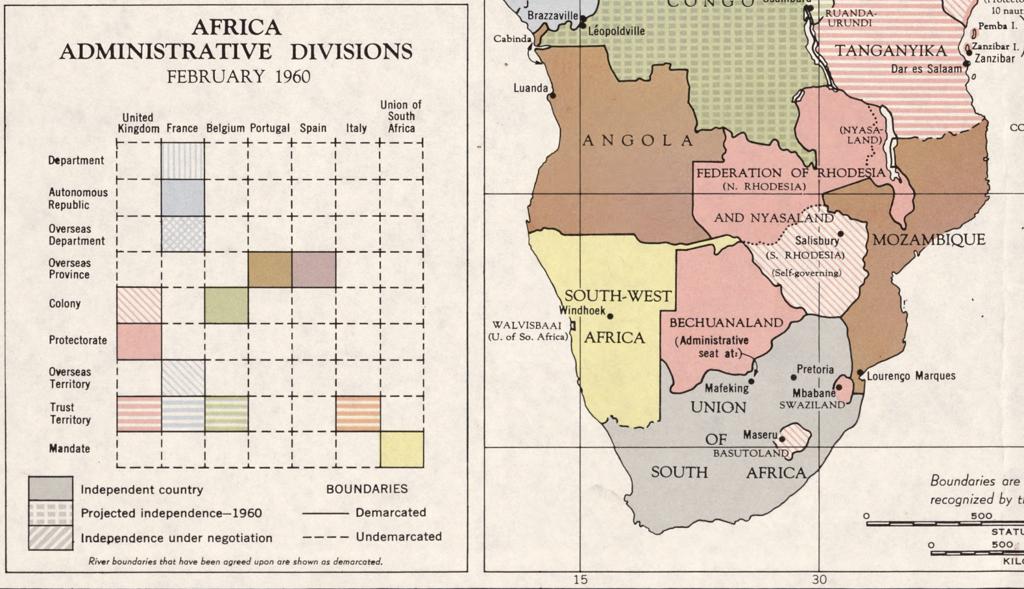
In South Africa, the Black majority was fighting for rights and enfranchisement against a brutal Apartheid state. In the Portuguese colonies, the Dictatorship flatly refused any calls for independence, and increasingly used violence to crush nascent liberation movements. It was, as Portuguese historian José Pedro Monteiro called it, “…a critical moment for projects of white supremacy on the African continent.”
What is rhodesia?
Rhodesia was a country on the border of Mozambique which existed from 1965 to 1979, corresponding to modern-day Zimbabwe. Prior to 1965, it was a colony of the British Empire. Both the colony and country were based on a brutal, racist caste-system where white colonizers individually and institutionally abused the Black native peoples. This led to the Rhodesian Bush War (1964–1979), probably better known as the Zimbabwe War for Independence. Rhodesian society was so profoundly racist that it even embarrassed the British, and the war was marked by the worst possible crimes against humanity committed by the white minority. Maybe unsurprisingly, it is thought of with nostalgia by white supremacists to this day.
For more, a good place to start is A History of Zimbabwe by Alois S. Mlambo.
The Unveiling
At the unveiling of the Compass Rose on August 5, 1960, the South African Ambassador left little doubt about how his government understood this gift.
contemporary account
“The Infante’s efforts established a noble tradition, and even today, the Portuguese are quick to resist the forces that seek to destroy the world, and to stand firm in the face of criticism and a lack of understanding, while at the same time continuing their mission to civilize and develop their peoples and their overseas provinces.”
Though couched in the language of the Cold War, the speech is revealing. The “forces that seek to destroy the world” is flexible, deliberately—it can mean communists, anti-colonial revolution, or both. His reference to Portugal’s “to stand firm in the face of criticism and a lack of understanding” reflects a shared perspective that minimized international condemnation. His language of “…to civilize and develop their peoples and their overseas provinces”, is verbatim adopting Portuguese imperial rhetoric. “Overseas provinces” (províncias ultramarinas) was the Estado Novo‘s preferred term, reflecting its insistence that Portugal possessed no colonies at all. By adopting Portugal’s own official language, the ambassador was endorsing not just Portugal’s past as a maritime power, but its contemporary colonial project.
When responding, the Portuguese President, Américo Tomás, doesn’t repeat the imperial rhetoric, but does state that this is more than an artistic donation:
contemporary account
“…this compass rose… represents, at the base of this monument, a symbol of another reality: expressed through the understanding, friendship, and the close ties that exist between our two nations.”
The Avalanche Begins
The ceremony proved to be more than symbolic.
- The Sharpeville Massacre was March of 1960.
The compass rose was inaugurated in August of 1960.
- Angola’s war for independence began six months later, in February 1961.
Salazar asked for help from his NATO allies like the US and UK. That help didn’t arrive.
- Portuguese Guinea-Bissau rebelled in 1963.
So Salazar turned to South Africa and Rhodesia for help.
- Portuguese Mozambique followed in 1964.
Portugal, Rhodesia and South Africa started to work together militarily.
- The South African border war against independence fighters began in 1966; that same year, Black Rhodesians went to war against the white-minority government in order to create the nation of Zimbabwe.
Now the entire region was at war. Each of these wars has a different name, but they are all connected. Some of the independence movements worked together (though some fought each other too). But the three white-majority powers were coordinating and working across borders too. This ultimately led to a full-scale military alliance between Portugal, Rhodesia, and South Africa against the African independence movements in 1970, called the Alcora Exercise.
The Portuguese understood that this “white alliance” was a bad look and flew in the face of their propaganda about being a multiracial paradise. So they made sure to keep it a secret.
The Alcora alliance crumbled in 1974, when the Portuguese dictatorship was overthrown. But the secret of the alliance stayed buried for forty years. It only became publicly known in the 2010s, due to the dogged research of historians working with Portuguese and South African secret government documents that had just been declassified.
Moral High Ground?
The US wasn’t always in the right here. The John F. Kennedy administration did not support the “White Redoubt”, and advised Salazar to let go of the colonies in 1961. But as the wars ground on, it became a theater of the Cold War. The US shifted positions towards backing anti-communist factions, including, sometimes, the Portuguese.
Not Just a Mosaic
Returning to Belém and the compass rose, it is not a “neutral” celebration of “heritage”. It is an out-of-touch celebration of an Empire that was founded on violence, slavery and exploitation. But it’s more than even that.
It was a gift: not an innocent decorative gift, but a public symbol of the relationship between two governments who became more and more united in defending white rule in southern Africa no matter the cost. Seeing it used, as it is, by tour guides to regale audiences of the greatness of the Portuguese Empire is stomach-turning. It has no place in modern, multicultural Lisbon, where the dreams of Empire deserve to be as dead as the Empire itself.
Since it was a gift, it seems only fitting that we return it, with grace, to the gifter. Perhaps in South Africa they can use the good Portuguese limestone to create something better.